Thursday, June 19, 2014

Manchester Madness

 ~My many and varied travels have brought me to the city of Manchester, among the rolling hills and forests of New Hampshire. I took advantage of the sunny, windy spring days here to hike a bit, and found some geocaches hidden in local parks.

Dorrs Pond, adjacent to Livingston Park.

A stream leading out of the park.
Mama duck out  for a swim with her four ducklings!

Graffiti(?) on a boulder out in the woods off of the path in Derryfield Park. Three deer heads? Are they liars? Oh deer...

More odd graffiti on the other side of the boulder. An evil popsicle?

A mysterious sign on a telephone pole near the city reservoir. What could it mean?


The Weston Observatory, built in 1896-97 with funds donated by former Manchester mayor (and later New Hampshire governor) James A. Weston, is located on top of a hill near a reservoir adjacent to Derryfield Park. The tower is 66 feet tall and supposedly has a great view of the surrounding area from the top. Sadly, the gate was padlocked and the door was closed when I found it. It's on the National Register of Historic Places.
Outside the tower are two cannons, each weighing over 1400 pounds.

Sunday, April 13, 2014

Vulcan Park

~While in Birmingham, Alabama last week, I visited Vulcan Park and Museum. It's on top of Red Mountain south of the city, which is riddled with old mine shafts from Birmingham's iron mining days. The park contains a museum and visitor's center, but the highlight is a huge statue of the Roman deity Vulcan, god of the Forge, on top of a brick tower:

^ Vulcan is the largest cast-iron statue in the world (it's 56 feet tall), and was commissioned to showcase the industrial achievements of Birmingham for the 1904 World's Fair in St. Louis, Missouri.

 ^ A closer look at Vulcan. He's huge!

^ The statue was designed by Italian-born sculptor Giuseppe Moretti, who created the hollow clay models for each piece of the statue in New Jersey. The clay casts were shipped by railroad to Birmingham, where workers from the Birmingham Steel and Iron Company worked feverishly to create the statue. They poured molten iron into each section of the hollow clay casts, allowed it to cool, and the cracked open the casts, revealing the completed cast-iron pieces. The pieces were assembled into the statue; all together, the combined body, forge, and spearpoint weigh 120,000 pounds.


^ Vulcan looking towards the moon


^ It's quite a climb to the top (I took the stairs -- all 119 of them -- instead of the elevator). The view of downtown Birmingham is worth it, though.


^ Taken from outside the visitor's center: the tower and the elevator frame a view of the moon.


^ The plaza outside of the visitor's center is a map of the area; the different colors indicate the geology of each area. See that skinny red line left of center? That's a vein of iron ore that runs through the area. It formed over 300 million years ago when iron-fixing bacteria congregated along a rock layer. In the present day, the reddish rocks are a common site on the appropriately-named Red Mountain and similar areas along the iron seam. The ore was mined, shipped into the city, and smelted to extract the iron from the ore.

 ^ Mining the iron ore was a tough business; the labor was intense and the rate of injuries and fatalities was high. But the booming industry attracted workers from all over the country. This display in the museum showed some of their stories. See the guy on the right? He was a convict, sentenced to hard labor in the iron mines as punishment for petty theft. His horrific death (tortured by overseers and thrown into boiling water) sparked national outrage to reform the convict-labor system that was widely in use at the turn of the century.

 ^ Different types of rock mined in the Birmingham area, and ingots of "pig iron" on the right. When ore is smelted to extract the iron, the resulting molten iron is channeled into a series of long containers to cool and harden. Because the containers resemble feeding troughs for pigs on a farm, it gave rise to the name pig iron. The pig iron provided a standardized shape that could be easily transported and melted down or worked later at another location.

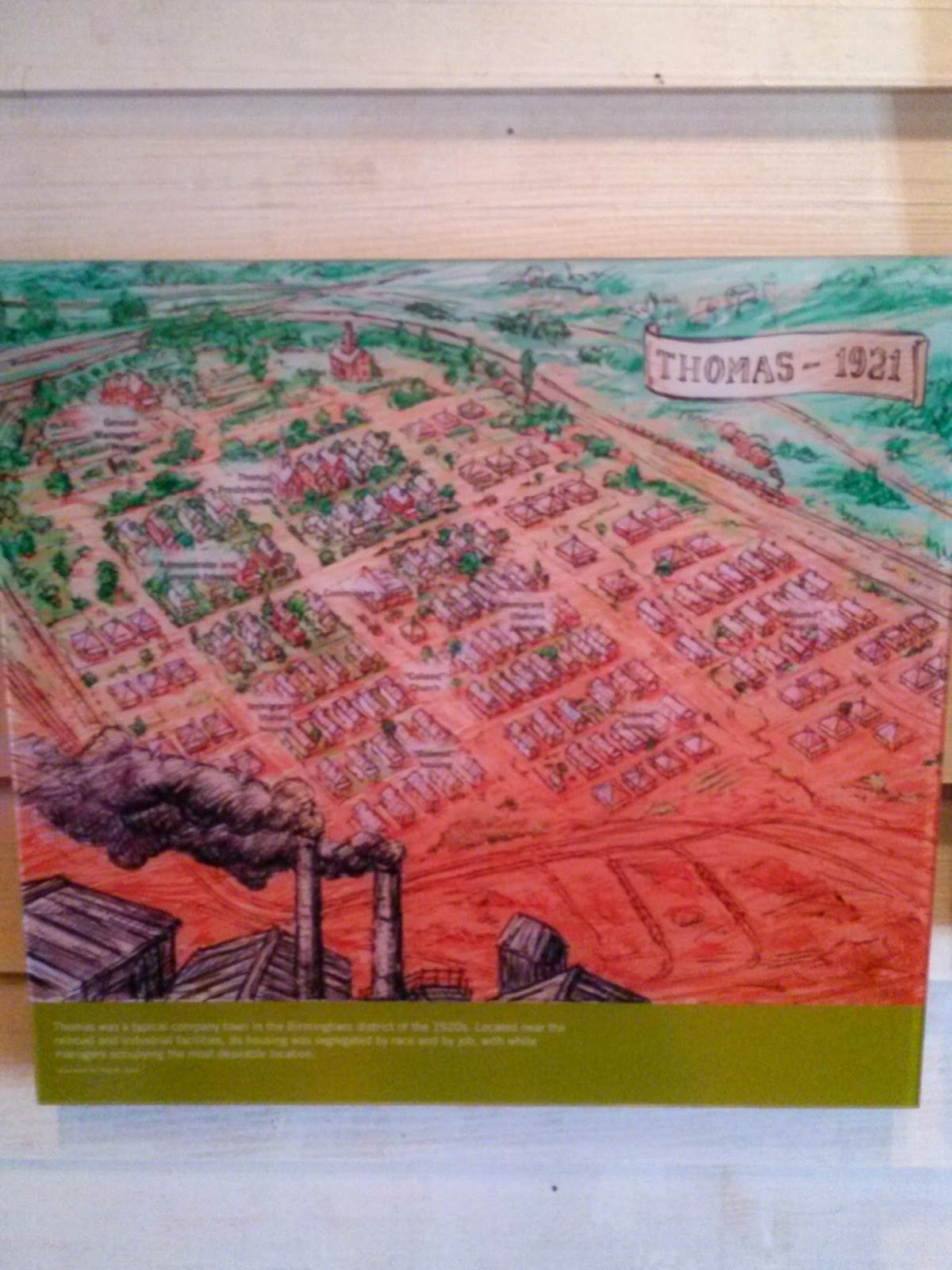
^ The industrial economy of Birmingham was dominated by a handful of large companies that controlled the entire iron process, from mining all the way to smelting, steelworking, and beyond. The labor force was often housed in company towns, where everything was owned by the company. Workers were provided housing and so forth, but this sometimes resulted in workers being trapped in the town, since they could owe more to the company stores than they earned. Above is a map of a company town in the Birmingham area from 1921.

 ^ Recreation of a company general store.

 ^ When Birmingham's iron mining economy began to take off in the late 1800s, the city government launched an ambitious plan for future expansion. Above is the grid plan they laid out and constructed, well before there was the population to accommodate such a large area. Their longsighted planning paid off: the booming economy attracted people in droves, and the grid provided an efficient layout for growth that still exists today. It uses a streets-and-avenues system that is immediately familiar to anyone who has spent time in Manhattan.


^ Map of the 1904 World's Fair in St. Louis. During the Fair, the statue of Vulcan was housed in the Palace of Mines and Metallurgy (the rectangular building second from the left on the left edge of the map). The statue was a huge hit and won a Grand Prize. Several cities tendered offers to purchase the statue, but it was ultimately taken back to Birmingham.


^ After being shipped back to Birmingham, Vulcan spent the next three decades at the Alabama State Fairgrounds. He became a popular draw and advertising image, photographed or drawn holding ice cream, pickles, Coca-Cola, and other products. In the 1920s it was disassembled and repainted from the original gray to flesh tone.  During a 1999 restoration, the statue was repainted gray and an internal metal skeleton was installed to support the formerly self-supporting statue, which had by that time begun to fall apart. 

How fragile the works of man are! A metal statue, seemingly impervious to the elements, nearly laid low after less than a century of exposure to nature.

 ^ In the 1930s, a WPA project constructed Vulcan Park to house the statue at its present site atop Red Mountain, atop a 126-foot sandstone tower. In 1946, the chamber of commerce installed a neon light on the statue that would glow green, except during the 24 hours following any fatal traffic accident in the city, during which the light was changed to glow red.


 ^ During the 1904 World's Fair, souvenir statues of Vulcan sold like hot cakes. Today, they are prized collectibles. Here are some from the museum's collection.


 ^ Vulcan has inspired many pieces of artwork on display in the musueum. Remember, it's Vul-CAN, not Vul-CAN'T!

 ^ A futuristic Vulcan?

 ^ A more realistic depiction of Vulcan atop his tower.

^ Vulcan in stained glass.

 ^ Commemorative Vulcan plates.

 ^ Vulcan in LEGO: clearly the best piece of Vulcan art on display.

If you ever find yourself in Birmingham, Vulcan Park is well worth a visit. It's less than 15 minutes from downtown.

Monday, March 10, 2014

Rodeo!

~I was in Houston last week, during a time when almost all of the hotels in the area were either sold out or were ridiculously expensive. Why, you might ask, was this the case? Was there a convention in town? Some sort of event at the hospital complex? No, the answer is something much more Texan: a Rodeo! Specifically, the Houston Livestock Show and Rodeo, a three-week extravaganza currently taking place inside Reliant Park (a sports and event venue that includes Reliant Stadium and the Astrodome).

I saw quite a few people milling around Houston that week decked out in full Western gear, along with trucks carrying contents that alternately moo'd and squealed. The hotels did their part too, decorating for the occasion:


There was also a boot-cleaning station. I must admit that I was a little disappointed at the lack of a hitching post for horses, though.

Sunday, January 19, 2014

CHOOSE!

Found in the business center of a hotel in Toronto:

...words fail me.

Wednesday, January 8, 2014

Superiority

~Spotted on the wrapper of my chopsticks while eating some pad Thai at a Noodles & Company restaurant:


Sometimes, it's the little things in life that matter.

Monday, January 6, 2014

Mount Vernon

~Here are some pictures that I took while touring Mount Vernon, the estate of George Washington in Virginia.  The land had been in Washington's family since 1674, and prior to George owning it, it belonged to his half-brother Lawrence, who left most of the estate to George; by 1761 he had inherited sole ownership of Mount Vernon.  He then embarked on an ambitious plan of building, expansion, and development that he continued with throughout his life, both before and after his presidency.

The main house of the estate.  George Washington inherited this house when it was smaller, and he had it enlarged by adding new wings on either side.
The back of the house, atop a steep hill.  Many foreign leaders have visited the house while in the U.S. (including, amusingly, British royalty). See that row of chairs?  They're great for relaxing and seeing the view of the Potomac River, below:
View of the Potomac from the back of Mount Vernon (click on the image for a larger panoramic view).  What a great vantage point! The proximity to the river also enabled the estate to harvest large amounts of fish from the river.


View from the side. The tall tree is a famous 160 year-old, 140 foot tall Pecan tree. See how it leans to the right? That's because it was bent by a massive storm in the early 1900s. Notice also the other buildings connected to and apart from the main house; Mount Vernon is not just a mansion, it's a collection of buildings and farms.

This official visitor's guide map to Mount Vernon helps to give a sense of scale to the estate. The buildings on the right are the museum and visitors center, and the buildings from left-center all the way to the right are part of the actual estate.  You can access an interactive version of the map at this URL: http://www.mountvernon.org/visit-his-estate/map
Washington's tomb is located on the grounds of the estate, alongside grave markers for other family members.

Interior of the tomb.  I wonder if his remains are really inside that marble casket?

A memorial to the slaves of Mount Vernon, constructed in 1983. Washington inherited, purchased, and rented slaves, who worked the fields and did other work to maintain the estate. Like Monticello, it's a strange contrast: the estate and grounds are beautiful, and the owner clearly put a lot of work into planning and management, but ultimately the beautiful buildings and productive fields were the product of forced labor. The area that this memorial was built on was originally used as an unmarked grave site for slaves that died at Mount Vernon; the only slave known to be buried here is William Lee, who served Washington during the Revolution.

Washington was personally uncomfortable with slavery (his will freed all of his slaves), but he was a man of his time, and like other Virginia estate owners, he did use slave labor.  Politically, did not want to risk splitting the young United States apart by attempting to abolish slavery nationwide, and he signed the Fugitive Slave Law and provided military support to slave owners in Haiti during the revolt there.  Towards the end of his life, he increasingly expressed disgust with slavery and supported efforts towards gradual emancipation. He was the only Founding Father to free his slaves in his will.  You can learn more about George Washington and slavery here: http://www.mountvernon.org/slavery


A blacksmith works at the smithy, located in a small building on the estate.  Note his very large right arm...

Peanut, a turkey pardoned by the President of the United States. Mount Vernon is where all of the pardoned turkeys go to live out the remainder of their not-terribly-long lives.

The profoundly stupid custom of the President "pardoning" a turkey was set into motion by Ronald Reagan during the the Iran-Contra affair. At the time, Reagan was under pressure to give a presidential pardon to Oliver North, who had been convicted of lying to Congress over the sale of weapons to Iran and diverting the resulting funds to rebels in Nicaragua. So Reagan joked about pardoning a turkey in place of pardoning North, who was given an extremely lenient sentence which was eventually overturned (with help from the ACLU, no less). This was not an "official" pardon of a turkey; that was given by the next President, George H.W. Bush, who started the tradition by officially pardoning a turkey for Thanksgiving. Subsequent Presidents have carried on this bizarre custom.  Pardoning them for what, though? Gobbling?

A gingerbread house display of buildings at Mount Vernon, made by students at a local school.

The Man Himself.

When I said "Mount Vernon, or bust!", this wasn't what I had in mind.

A sword owned by George Washington, now in the museum at Mount Vernon.

George and Martha washington, along with two of Martha's grandchildren, Eleanor ("Nelly") Parke Custis (b. 1779) and George Washington ("Washy") Parke Custis (b. 1781). Their father died in the Battle of Yorktown during the Revolution, and George and Martha took care of them after that.
There was also a fascinating display of books owned by George Washington from his library at Mount Vernon. Unlike most of the other Founding Fathers, Washington had little in the way of formal education (something he expressed regret for later in life) and was largely self-taught. He had a lifelong love of learning and recognized education to be of critical importance for the new nation. He also enjoyed reading for pleasure -- Don Quixote was a favorite novel of his.

George Washington is a fascinating historical figure who had a profound impact on our nation, and Mount Vernon is one of the best places to learn about his life and the events that formed the United States. It's well worth a visit.

Wednesday, January 1, 2014

Malvern Hill Battlefield

~I recently traveled to Mount Vernon, the estate of George Washington. On the way, I stopped at the Malvern Hill battlefield, part of the Richmond National Battlefield historic site managed by the National Park Service.  Malvern Hill was the site of a battle between Union and Confederate forces on July 1, 1862. Here are some pictures that I took of the battlefield:

Dad and I in front of one of the (reproduction) cannons on the Union battle line.

A line of the cannons commanded the top of the hill.

The cannons pointed down a gently sloping hill that thousands of Confederate troops charged up. This was a bad idea -- none of them made it to the artillery line.

A panoramic view of the Union artillery position.  Click on the picture for a better look.


You can learn more about the battle of Malvern Hill here: http://en.wikipedia.org/wiki/Battle_of_Malvern_Hill

Tomorrow: Mount Vernon!