Friday, July 19, 2013

Rochester

~My latest travels recently brought me to the lakeside city of Rochester in New York, home of Kodak.  Here are some pictures I took while I was there:


The Council, by Bill Stewart, 1991.  This strange sculpture is in the Rochester airport, and is based on Inuit art.

Another unusual piece of work in the Rochester airport: a clock surrounded by domed flags of several nations.  The signs in front of each flag tell a traditional story from that country.

Below are pictures from a military exhibit at the airport.  It was a neat collection of models and artifacts from various wars:


Edward Mott Moore, by Thomas Hudson Jones, 1927.  Moore was a surgeon in Rochester who was known as the "Father of the Rochester Park System". As president of the Park Commission, he developed the city's public green spaces.  Appropriately, this sculpture is in the Genesee Valley Park.

A grove of trees in Genesee Valley Park.

The Genesee River, which crosses the Erie Canal.  There were a few members of the University of Rochester crew team out practicing.


Sunday, July 14, 2013

Microscopy, part 1

~I recently acquired a digital microscope (a Celestron LCD Digital Microscope), and I've been having fun with some amateur microscopy.  It has a base zoom of 10x, and objective lenses of 4x, 10x, and 40x magnification, along with a digital zoom of up to 4x (so at maximum combined digital/optical zoom, it has a magnification of 1600x).

Here are pictures taken with the microscope's built-in digital camera of the sample slides that came with the device:

Dicotyledon wood stem, 40x


Dicotyledon wood stem, 100x.  From here we can better see individual cells.

Dicotyledon wood stem, 400x.  The magnification is almost too strong at this level, and things start to get blurry.  But isn't it interesting how the cells of different shapes and sizes connect to each other?

Stem of cotton, 40x. Similar to the wood stem from before, but with large of hexagonal cells in the center.

Stem of cotton, 100x.  Let's take a closer look at those cells in the middle... 
Stem of cotton, 400x.  See the boundary between the larger cells in the lower-right and the smaller ones to the left?
 
Stem of cotton, 100x.  This image was taken near the edge of the stem.  Notice the much thicker outer layer that protects the delicate cells in the upper-left.

Stem of cotton, 400x.  Individual cells are packed against each other in this plant cut.


Mature pine wood, 40x.  The outer edge is rough and torn up at this magnification.

Mature pine wood, 100x. Notice the beautiful linear arrangement of plant cells, almost perfectly lined up.

Mature pine wood, 100x.  This is the same plant, but the image is taken at the edge of the sample to show how different the cells there are from he previous image.
 
Mature pine wood, 400x.  This is a closer view of the lined-up cells from before.

Mature pine wood, 400x.  A close-up of the protective outer edge.

Onion skin, 40x.  Notice how much more simple this image appears to be than the complex arrangement of cells from the previous images.  The cells interlock with each other like puzzle pieces.

Onion skin, 100x.  The cells aren't a single defined shape; instead, it appears that individual cells seem to have grown and expanded into wherever there was space to fill in gaps in the skin.

Onion skin, 1600x.  This is the maximum magnification of the microscope.  Is this a cell nucleus?

The same image as above, but seen through a green color filter that is built into the microscope.


Fly's leg, 40x.  Look at all of those tiny hairs.


Fly's leg, 100x with color filter.  A closer view of the hairs.  If you ever wonder why flies at rest are constantly grooming their legs, it's to keep all of this clean so they can be sensitive to the tiniest movement...like a gigantic hand trying to swat them.

Fly's leg, 400x with color filter.  This didn't come out too well; I need to experiment more with the various lighting and color settings of the microscope.  But you can see the follicles at the base of each hair, and how some of the follicles are missing hairs.
I hope you've enjoyed this glimpse into the microscopic world around us.  I'll be taking more pictures and videos in the future with the microscope, so stay tuned for more.~

Tuesday, July 2, 2013

Kaboom!

~An unmanned Proton-M rocket carrying navigational satellites crashed earlier today shortly after launch from Baikonur Cosmodrome in Kazakhstan.  The crash was caught on amateur video here; note the delayed shockwave that hits near the end:


^ "Hey Dmitri, I'm not a rocket scientist, but I don't think it's supposed to go in that direction..."

Wednesday, June 26, 2013

Anderson

~Here are some pictures from my trip to the town of Anderson in South Carolina:

This fountain is outside of the Anderson County Museum, which has a lot of interesting historical exhibits about the area.  The fountain honors Robert Anderson (for whom the town and county are named), who was a military officer during the American Revolution and later a politician in South Carolina:


This obelisk is a monument of James L. Orr, a local philanthropist and cotton mill who lived in the late 1800s.  The top of this cenotaph is not actually broken -- the monument was built that way to represent how Orr's life was cut short.  Note the "JLO" initials design 2/3 up the monument:


A Revolutionary War-era cannon affectionately known as Ol' Reformer, outside the museum:


A bell made in Baltimore in the year 1900.  This thing is LOUD:


...and underneath the bell, a geocache!:

Tuesday, June 25, 2013

San Jose Municipal Rose Garden

~After visiting the Winchester Mystery House, I stopped by the Municipal Rose Garden in San Jose.  Below are some pictures from the beautiful garden.

Fountain in the middle of the garden:


 Pink roses near the fountain:


The roses went on and on...I wonder how much water it takes to keep them all in shape?:


Red roses:


Yellow rose:


Panorama of the San Jose Municipal Rose Garden (click on the picture for a larger view):


You can see a map of all the rose varieties currently in the garden here.  If you happen to find yourself in or near San Jose, why not visit the garden to stop and smell the roses?

Monday, June 24, 2013

Winchester Mystery House

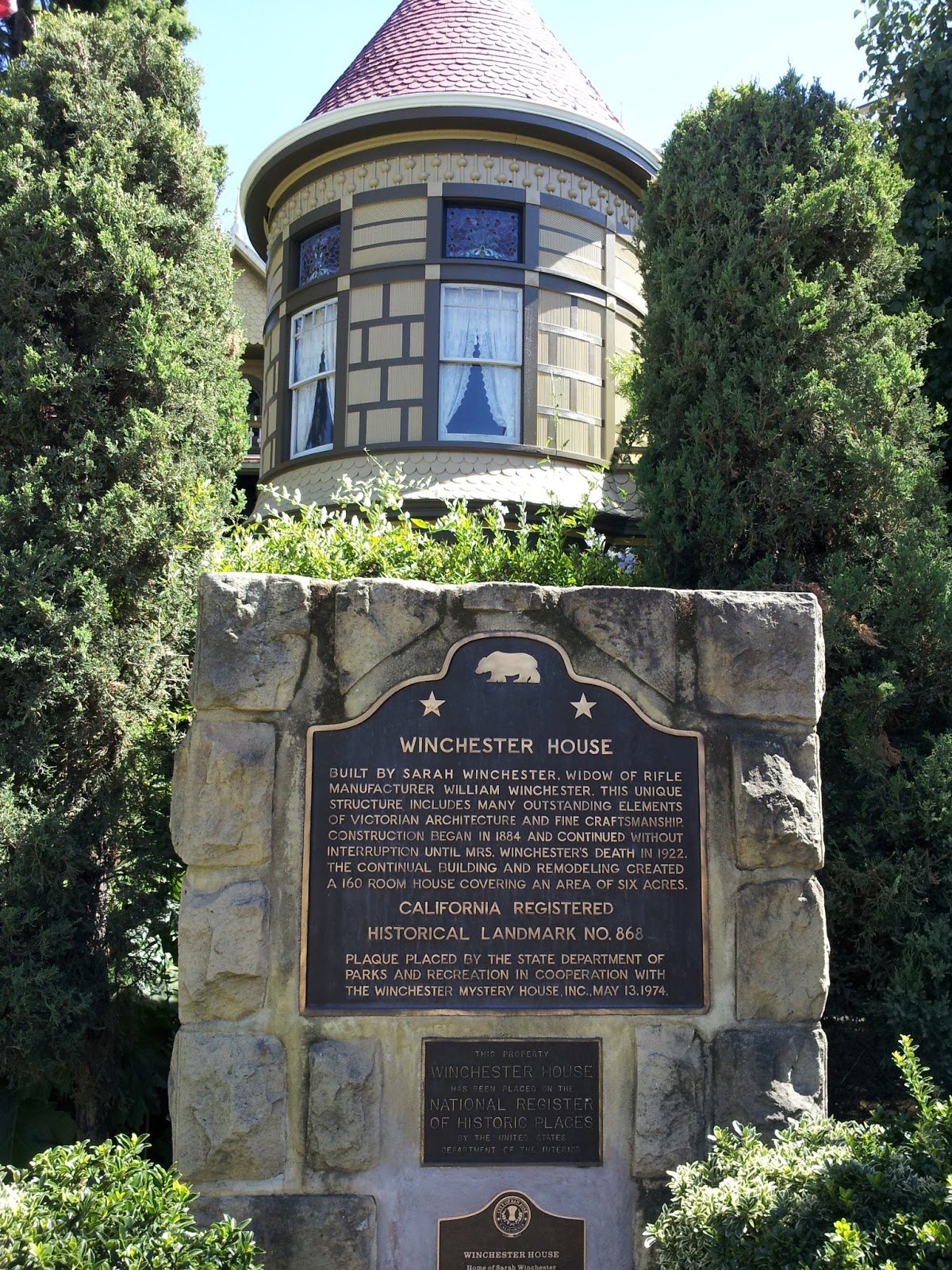
~Last week in San Jose, I managed to find time for a tour of the famous Winchester Mystery House:


^ The story of this California Registered Historic Landmark is fascinating.  The house was built at the direction of Sarah Winchester, who married firearms industrialist William Winchester.  Mr. Winchester's family business, the Winchester Repeating Arms Company, made the guns that "won the west" and also made a quite literal killing in the American Civil War.

Sarah Winchester (1839-1922)
Despite the immense wealth that her marriage bought her, Mrs. Winchester's life was doomed to tragedy: within a short span of time, her infant child, husband, and in-laws all suddenly died.  Overwhelmed, she sought guidance from a psychic as to why she was so afflicted. The psychic told her that the deaths were caused by the angry spirits of the many, many people who were killed by Winchester guns, and that only two things would appease them: Sarah Winchester had to move away from her home in Connecticut and out to the West Coast, and she was to buy an existing house and continue to build it forever.


Sarah Winchester dutifully moved out to California, purchased a small farmhouse, and hired laborers for construction, which continued 24 hours a day, unceasingly, from 1884 until her death in 1922.  However, she did not hire an architect and had no architectural training, instead relying on seances to decide what to build next.  The result was what came to be known as the Winchester Mystery House:


^ Map of the Winchester Mystery House. The ludicrous sprawl makes it look a bit like a miniature Los Angeles...


^ The famous second-story "Door To Nowhere".

The Winchester Mystery House is filled with bizarre and mostly useless architectural features like the pointlessly dangerous doorway you see above.  There are doors that open onto walls, windows in floors, staircases that go into ceilings, windows that open to other windows, beautiful and expensive stained glass facing away from the path of the sun, and fireplaces not connected to chimneys.  There are roughly 160 rooms; the structure originally included a seven-story tower, but after earthquake damage the upper levels were removed, and most of the house today is four stories.  Four very weird stories.

Many of the rooms and features of the house also reflect Sarah Winchester's fascination with the number 13 and with spiderweb designs.  For example, many of the stained-glass windows have 13 circles in them, the hand-painted sinks have 13 drainage holes, staircases have 13 steps, etc. My favorite example is a beautiful German-made chandelier in the main ballroom which was made to hold 12 candles, to which a 13th candle-holder has been crudely attached.

 To commemorate this obsession with all things thirteen, the staff of the Winchester Mystery House holds special flashlight-only tours every Friday the 13th.  I imagine Halloween is a big draw as well.  I wonder if they give out king-size candy bars?


^ View of the House from the gardens.


Sarah Winchester could afford to build all of this because she was extremely rich -- she inherited over $20 million when her husband died, and also a 50% stake in the Winchester Repeating Arms Company.  That level of ownership provided her with an income of what today would be over $30,000 per day.  Construction of the house was estimated to have cost around $5.5 million (or over $75 million today).

So despite the strange design (or lack thereof) of the House, the huge amount of money used to build it means that it is built of the highest-quality materials.  Many of the rooms are intricately decorated with handmade carvings, expensive wallpaper, stained-glass, and so forth.  The original furnishings (many, many truckloads of them) were sold off after Sarah Winchester's death, so the period furnishings there at present are donations.

Photography of the inside is unfortunately prohibited, but there are also garden areas and outbuildings surrounding the house.  The mansion was once the center of a large farming estate but now is surrounded by downtown San Jose, with a movie theater and mall as its neighbors.

There are several unusual fountains and statues in the front gardens:


^ The Winchester Mystery House is quite a place and is an interesting attraction, well worth touring if you happen to be in San Jose.  There's also a museum of Winchester firearms and, this being America, an extensive gift shop.  Have fun, and don't get lost in the House.

Friday, June 21, 2013

"We named the monkey Jack"

Part 1:


^ "Monkeys are born thieves!"

Part 2:


^ "With a little training, you can teach your monkey to wear clothes!"